
Building curiosity can nurture a voice before the words arrive
Even when children cannot speak yet, they are still thinking and observing
Written by |





One of the most powerful things a child can learn is how to ask good questions. Questions are how children make sense of the world, test ideas, and discover new possibilities. As parents and educators, we often focus on teaching children answers. Yet the ability to ask thoughtful questions may be even more important.
Thought experiment
As a teacher, I once used a thought experiment often associated with Leonardo da Vinci. The idea is simple: Write down 100 questions about anything you are curious about. The first questions come easily, but as you continue the exercise, they become harder and more creative. By the time you reach the later questions, your thinking begins to shift. Ideas connect in unexpected ways, and curiosity starts to guide the process.
Whether the exercise truly comes from da Vinci or not, the concept is powerful. When I did the activity with my students, I asked them to write down as many questions as they could about the world around them. There were no wrong questions. The goal was simply to build curiosity.
Watching the process unfold was fascinating. The first few questions were predictable, but something interesting happened as the students pushed themselves to keep going. Their thinking became more imaginative and complex. Questions began to connect ideas across science, history, and everyday life. It was a reminder that curiosity is not just a personality trait. It is a cognitive skill that can be developed and strengthened over time.
Encouraging children to ask questions brings several cognitive benefits. When children ask questions regularly, they strengthen their critical thinking by learning to analyze information rather than simply accept it. Questioning also leads to deeper understanding. Instead of memorizing facts, children begin exploring why and how things work.
Curiosity improves problem-solving because people who are good at it start by asking good questions that break down challenges into manageable parts. Creativity also grows when children are encouraged to wonder and explore possibilities beyond conventional answers. Finally, children who feel comfortable asking questions often develop stronger communication skills. They learn how to express their thoughts, challenge ideas respectfully, and participate confidently in conversations.
These lessons about curiosity became especially meaningful in our own home with our daughter, Rylae-Ann.

Applying the technique
Rylae-Ann was born with aromatic l-amino acid decarboxylase (AADC) deficiency, a rare genetic disorder that affects the production of important neurotransmitters like dopamine and serotonin. Before receiving gene therapy as a toddler, her speech was very limited. Like many children with AADC deficiency, communication and motor development were significant challenges.
But even during those early years, my wife, Judy, and I still asked her questions.
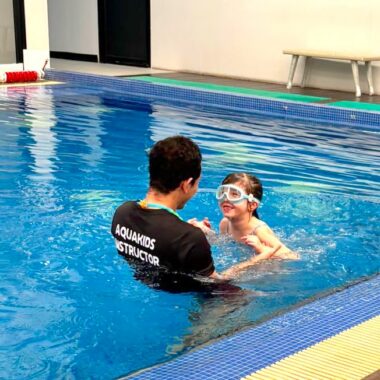
By asking questions and observing her swim coach, Rylae-Ann has improved in swimming. (Photo by Richard E. Poulin III)
Rylae-Ann couldn’t always respond with words, but that didn’t stop us. We role modeled both the language and the thinking behind the questions. We narrated what we were doing, wondered out loud, and asked simple questions as if she were part of the conversation. “Why do you think the ball rolled away?” “What should we try next?” “I wonder what will happen if we do this?”
In many ways, we were practicing curiosity for her until she could begin doing it herself.
After Rylae-Ann received gene therapy and her speech gradually improved, something wonderful started to happen. She began asking her own questions. At first, they were simple. Then they became more frequent. Today, her questions seem endless, and her curiosity has no bounds.
Sometimes those questions turn into lively debates at home. Other times, they appear in the classroom as she tries to understand why something works the way it does. Even during swim lessons, she asks her instructor how she can improve.
For me, those moments are reminders of how powerful curiosity can be. Asking questions means she is thinking, reflecting, and actively trying to improve.
Our experience has also taught me something important that I hope other families of children with AADC deficiency remember. Curiosity does not have to wait for perfect speech.
Even when children cannot speak yet, they are still thinking. They are observing the world around them. As parents, we can role model curiosity by asking questions, sharing ideas, and inviting them into the process of discovery. One day, those questions may lead Rylae-Ann on her own journey. That endless curiosity is exactly what we hoped to nurture.
Note: AADC News is strictly a news and information website about the disease. It does not provide medical advice, diagnosis, or treatment. This content is not intended to be a substitute for professional medical advice, diagnosis, or treatment. Always seek the advice of your physician or other qualified health provider with any questions you may have regarding a medical condition. Never disregard professional medical advice or delay in seeking it because of something you have read on this website. The opinions expressed in this column are not those of AADC News or its parent company, Bionews, and are intended to spark discussion about issues pertaining to aromatic l-amino acid decarboxylase deficiency.




Leave a comment
Fill in the required fields to post. Your email address will not be published.