
Finding patience and perseverance in the rare disease journey
This life I never expected has given me strength I never knew I had
Written by |





There were many times when my wife, Judy, and I almost lost our daughter, Rylae-Ann. The early years of her life were filled with medical emergencies, unanswered questions, and moments when the future felt painfully uncertain.
Aromatic l-amino acid decarboxylase (AADC) deficiency is not a journey anyone prepares for, and yet it became the path our family was placed on.
What I could never have expected, however, was how profoundly this journey would shape who I am. Not just as a parent, but as a person and a professional. Over the years, I’ve learned that parenting a child with a rare disease quietly builds a unique and powerful skill set, one forged through love, fear, resilience, and unwavering commitment.

Learning positivity
One comment I often receive from colleagues is about my positivity. It didn’t come naturally, but it was learned. Watching my daughter fight every single day to do things most people take for granted has completely changed my perspective. When progress is measured in seconds sitting upright, a new sound, or a brave attempt at independence, you learn to celebrate every small win.
Rylae-Ann has taught me to seek the good in each day, even when it feels heavy. That mindset has followed me into my professional life as a middle school principal. Small problems don’t weigh me down the way they once might have. I start and end my days with a smile because I’ve learned how precious those moments are. I’ve discovered positivity is contagious, and it has quietly spread into my workplace, shaping how I lead, support, and respond to others.
Leaving work at work
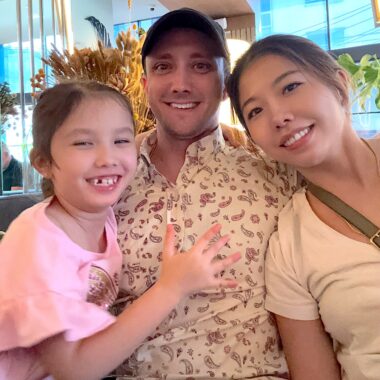
The Poulin family — from left, Rylae-Ann, Richard, and Judy — enjoys a snack at a cafe in Bangkok after a day of work and school. (Courtesy of Richard E. Poulin III)
I give 100% at work, but when I walk through the door at home, I try to give 110%. Judy and Rylae-Ann depend on it.
I know firsthand how challenging even the simplest routines can be for my daughter. Although she is becoming more independent each day, she still relies on us in ways that require patience, energy, and presence. Home is not a place where I can afford to be distracted or emotionally drained by the day’s frustrations.
When Rylae-Ann was thriving in the first grade, Judy made the brave decision to open her own school. This allowed her not only to help other children, but also to be fully present in supporting Rylae-Ann’s growth. With her background in special education, Judy has helped our daughter and many other students with challenges make incredible progress, but that progress has come through relentless effort, long days, and emotional exhaustion.
By 4 p.m. each day, Judy needs time to decompress, and that’s when I step in fully. To do that well, I cannot let an angry email from a parent or the endless responsibilities of being a middle school principal follow me home. Those frustrations stay at work.
By prioritizing tasks and working efficiently, I get to most of what needs to be done. Whatever remains can wait until the next day or even the next week, if necessary. Along with it, I leave behind the stress and emotional weight that don’t belong in my home. My family deserves my best, not what’s left over.
Perseverance and patience
If there are two qualities that parenting a child with AADC deficiency has strengthened the most, they are perseverance and patience.
Progress is rarely linear. There are setbacks, plateaus, and days when it feels like all our effort leads nowhere. But you learn to keep going anyway. You learn to trust the process, to show up consistently, and to believe that small steps still move you forward.
Patience becomes a daily practice — not just with your child, but with yourself and the world around you. You learn to slow down, to listen more closely, and to understand that growth happens on its own timeline. These lessons don’t stay at home; they shape how I approach challenges at work, how I support others, and how I respond under pressure.
A different kind of superpower
Caring for a child with AADC deficiency comes with undeniable challenges — ones that are physical, emotional, and mental. It tests every limit you think you have. But it also molds parents into something extraordinary.
You don’t wake up one day feeling like a superhero. It happens quietly, over years of showing up, staying strong when you’re exhausted, and loving fiercely even when you’re afraid. This journey has changed me in ways I never could have imagined, and while I would never wish this path on anyone, I am deeply grateful for the person it has helped me become.
Rylae-Ann didn’t just change our lives; she revealed strengths we never knew we had.
Note: AADC News is strictly a news and information website about the disease. It does not provide medical advice, diagnosis, or treatment. This content is not intended to be a substitute for professional medical advice, diagnosis, or treatment. Always seek the advice of your physician or other qualified health provider with any questions you may have regarding a medical condition. Never disregard professional medical advice or delay in seeking it because of something you have read on this website. The opinions expressed in this column are not those of AADC News or its parent company, Bionews, and are intended to spark discussion about issues pertaining to aromatic l-amino acid decarboxylase deficiency.


Leave a comment
Fill in the required fields to post. Your email address will not be published.