
How we protect our mental health as rare disease parents
5 lessons we've learned from caregiving for our daughter
Written by |





Behind every child, especially a child with complex needs, are parents carrying unseen emotional weight. Our daughter, Rylae-Ann, was born with aromatic l-amino acid decarboxylase (AADC) deficiency, a rare neurological condition that shaped every aspect of our early parenting journey.
While much of the focus rightly goes to the child, my wife, Judy, and I learned the hard way that parents’ mental health must also be protected, honored, and nurtured. Judy realized that if we were not operating at 100%, the level of care we provided to Rylae-Ann significantly decreased.
In honor of Parent Mental Health Day on Jan. 30, I’m sharing five lessons we’ve learned along the way, in the hope that other parents feel seen, supported, and less alone.

1. Give yourself permission to feel everything
Fear, grief, guilt, anger, hope, gratitude — often all in the same day. When Rylae-Ann was diagnosed, we felt pressure to be strong all the time, for her and for others. What we learned is that suppressing emotions only makes them heavier. It’s OK to grieve the journey you did not expect while still loving the child you have with your whole heart. Allowing yourself to feel does not mean you are weak. It means you are human.
2. You are more than a caregiver
When your child has a rare disease, parenting can quickly turn into full-time case management in what Judy and I refer to as a caregiver lifestyle. Appointments, therapies, medications, paperwork, advocacy — the list goes on and never seems to end. We slowly realized that we were losing ourselves in the process. Protecting your mental health means remembering that you are still a person, a partner, and an individual with needs and dreams beyond caregiving. Even small moments of reclaiming your identity matter. When possible, rely on technology and artificial intelligence tools to help make the process more efficient.
3. Accept help without guilt
Early on, we believed we had to do everything ourselves. As a father, I felt that accepting help was a failure of my duties. Over time, we learned that allowing others to support us did not diminish our role as parents; it strengthened it. Whether it is family watching your child, friends listening without fixing, or professionals offering guidance, support is not a weakness. It is a lifeline.
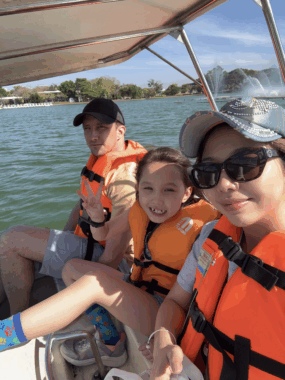
To achieve their therapy goals, reduce stress, and make memories, the Poulin family spends time paddling on a lake at a park in Thailand. (Courtesy of Richard E. Poulin III)
4. Celebrate progress, not comparisons
Rare disease parenting often comes with constant comparisons, milestone charts, other children, and even other patients. This can quietly erode mental health. We learned to shift our focus inward. Rylae-Ann’s progress, no matter how small it may seem to others, is meaningful. Celebrating her victories helped us reframe success and reduce the emotional toll of comparison. Our children are not exempt from making memories and celebrating success. It may look different, but it is no less meaningful.
5. Protect your relationship and communication
Stress, exhaustion, and fear can easily strain even the strongest partnerships. Judy and I learned that intentional communication was essential. Checking in with each other, acknowledging burnout, and giving grace during hard seasons helped us stay connected. A supported parent is a healthier parent, and a united partnership creates emotional safety for the whole family. In addition, we make time for date night, and we hold those dates as firmly as we do Rylae-Ann’s medical appointments.
Please remember that there is no measure of how much you must accomplish in a single day to be a good parent. Some days will feel light, others heavy, and some will stretch you to your limits. What matters most is not how much you do, but how well you care for yourself along the way. When your well-being is protected, the love, patience, and presence you give your child become even stronger. And in those moments, amid the challenges and quiet victories, you will continue to create meaningful memories that carry you forward on this journey.
Note: AADC News is strictly a news and information website about the disease. It does not provide medical advice, diagnosis, or treatment. This content is not intended to be a substitute for professional medical advice, diagnosis, or treatment. Always seek the advice of your physician or other qualified health provider with any questions you may have regarding a medical condition. Never disregard professional medical advice or delay in seeking it because of something you have read on this website. The opinions expressed in this column are not those of AADC News or its parent company, Bionews, and are intended to spark discussion about issues pertaining to aromatic l-amino acid decarboxylase deficiency.



Leave a comment
Fill in the required fields to post. Your email address will not be published.