
A rocket launch sparked real learning for our daughter with AADC deficiency
Homeschooling allows us to design education around real-world moments
Written by |





When NASA launches a rocket, most people watch for a few minutes, feel a sense of awe, and move on with their day. My wife, Judy, saw a week of lessons.
That is the difference between traditional schooling and intentional learning. One passes by moments. The other builds entire experiences around them.
Our journey to this point did not start with space. It started with survival, uncertainty, and a diagnosis that changed everything.
Our daughter, Rylae-Ann, was born with a rare disease called aromatic l-amino acid decarboxylase (AADC) deficiency. In the early years, our focus was not on academics but on developmental milestones, movement, speech, and regulation.
Every small milestone felt like a major victory. Before Rylae-Ann’s gene therapy, even basic communication was a challenge. After treatment, we entered a new phase filled with hope, progress, and a relentless drive to help her reach her full potential.
As educators, Judy and I did what we knew best. We planned. We structured. We worked on foundational skills and tried to build a bridge from where she was to where schools expected her to be.
Then we paused.

Transition to homeschool
We asked a simple but uncomfortable question: Were we preparing her for school or for life?
That question changed everything.
We chose to homeschool, not because we were stepping away from education, but because we wanted to move closer to what learning could truly be. As a certified special needs and elementary teacher, Judy now homeschools a small group of students, including Rylae-Ann.
Traditional education often leans heavily on memorization. Content is separated into neat boxes. Math at this time, science at that time, language somewhere in between. Students learn information, repeat it, and move on. It worked in a different era, but the world has changed.
Today, information is everywhere. With the rise of artificial intelligence (AI), knowing facts is no longer enough. Students need to think, connect, create, and adapt. Subjects no longer stand alone but are intertwined. Real-world problems don’t arrive labeled as “science” or “art.” They require a blend of skills.
That is exactly what Judy designed when she saw NASA’s announcement of the Artemis II launch toward the moon. Instead of a single lesson, she built a weeklong experience focused on space exploration, culminating in a shared viewing of the launch.
Prioritizing curiosity, creativity, and connection
The students began by reading and researching space. Not just memorizing planets, but asking questions. What is it like to live in space? How do astronauts prepare? Why do we explore beyond Earth? Curiosity drove the learning, not a worksheet.
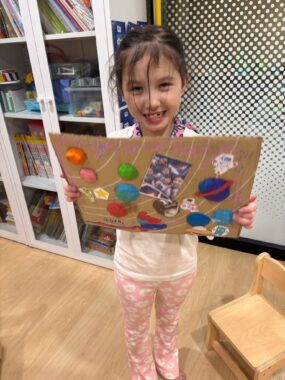
Rylae-Ann proudly shows off her solar system project. (Courtesy of Richard E. Poulin III)
From there, the learning expanded.
They used art to create their own solar systems. Paint, texture, color, and creativity transformed scientific concepts into something tangible. Planets were no longer just names in a textbook. They became something the students built with their own hands.
Then came communication.
Each student recorded a video presentation explaining their project. They shared what they learned, how they created it, and what fascinated them most. These videos were sent to parents, turning learning into a shared experience. It wasn’t about grades; it was about voice, confidence, and storytelling.
And then, in a way that reflects the future of education, they used AI to create images of themselves as astronauts. Not just playing dress-up, but imagining possibility. They saw themselves in roles that once felt far away.
In one week, they read, researched, created, presented, and used technology to extend their thinking. Literacy, science, art, communication, and technology blended into one cohesive experience.
That is transdisciplinary learning in action. More importantly, it was fun. You could see it in their engagement. You could hear it in their excitement. Learning wasn’t something they had to do; it was something they wanted to do.
For us, this is what homeschooling and alternative education can offer. It gives us the flexibility to meet children where they are. It allows us to design learning around real-world moments. It creates space for curiosity, creativity, and connection.
And for Rylae-Ann, it means something even more.
It means learning that adapts to her, instead of forcing her to adapt to a system. We still value academic skills. We still believe in structure. But we refuse to let those things limit what learning can be.
Because if a rocket launch can spark a week of meaningful, joyful, future-ready learning, then maybe education doesn’t need to be confined to a classroom or a schedule. Maybe it just needs someone willing to look up, see the possibility, and create the kind of future that once seemed impossible.
Note: AADC News is strictly a news and information website about the disease. It does not provide medical advice, diagnosis, or treatment. This content is not intended to be a substitute for professional medical advice, diagnosis, or treatment. Always seek the advice of your physician or other qualified health provider with any questions you may have regarding a medical condition. Never disregard professional medical advice or delay in seeking it because of something you have read on this website. The opinions expressed in this column are not those of AADC News or its parent company, Bionews, and are intended to spark discussion about issues pertaining to aromatic l-amino acid decarboxylase deficiency.

Leave a comment
Fill in the required fields to post. Your email address will not be published.