
Sleep was one of the biggest battles for our child with AADC deficiency
I wasn't going insane; I just needed to get a good night's sleep
Written by |





There was a stretch of time when I genuinely thought I was going insane.
Night after night, the crying came in waves that instantly snapped my wife, Judy, and me from our sleep, hearts racing, and already exhausted from the 24-hour care we provided during the day.
Our daughter, Rylae-Ann, was born with aromatic L-amino acid decarboxylase (AADC) deficiency. Before her gene therapy, sleep was one of our biggest battles. After treatment, many things improved. Sleep was still a journey. Judy took the lead in helping us find a way through it.
At first, we tried what most parents do: to push through, to power it out together. That sounds noble, but in reality, it just meant two exhausted parents making slower, worse decisions.
Then we took shifts.

Taking shifts

After playing in the pool, Rylae-Ann sleeps on her memory foam wedge. (Photo by Richard E. Poulin III)
It sounds simple, but it was one of the hardest adjustments we made. It is incredibly difficult to sleep while hearing your child cry and knowing your partner is the one carrying that moment alone and red-eyed. Every instinct tells you to get up and help. But we learned that protecting at least one person’s sleep at a time made us stronger as a team.
We picked days that worked for each of us. Some nights were mine. Some were Judy’s. It was not perfect, but it gave us precious rest.
Then came another realization: We could not do this alone.
Accepting support
As parents, especially in the rare disease world, there is a quiet pressure to carry everything. To be the expert, the caregiver, the therapist, the comforter, all at once. But that mindset limits you.
We began to accept help. We hired a nanny during the day. Family members came over. We shared our routines and strategies, but something interesting happened. They added their own ideas — small adjustments we had not considered. It reminded us that support is not just about relief. It is about growth.
But the biggest breakthrough was routine.
Establishing routines
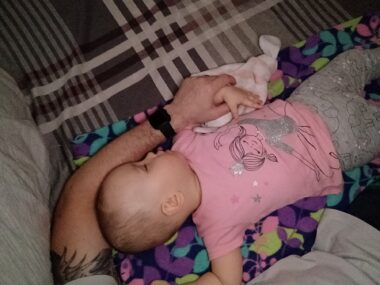
Rylae-Ann falls asleep after lying close to her dad and feeling his touch in a cool, dark room. (Courtesy of Richard E. Poulin III)
We committed to a routine, even when it felt pointless. Even when Rylae-Ann clearly was not tired. Same sequence. Every night.
All the lights went off, and the room was cooled down. Blinds were fully closed, so not a single ray of light could sneak in. Children with AADC deficiency often run warm, and a cooler environment made a noticeable difference.
Rylae-Ann slept on a memory foam wedge that helped regulate her temperature and kept her comfortable. Then came the part that took the most patience. We stayed with her.
At first, it meant snuggling beside her, barely moving. The smallest shift would wake her, and we would be back at the beginning. Over time, we got creative. A weighted pillow replaced the pressure of an arm. A plushie became a stand-in for our presence.
It was not immediate. It took practice. Trial and error. A lot of nights felt like setbacks.
We also became intentional with her day.
Planned physical activity
Physical therapy and swimming were scheduled before naps or bedtime whenever possible. Not just for development, but to help her body feel ready for rest. It is amazing how much sleep improves when the body has had a full day of meaningful movement.
Then came our wind-down routine.
A warm bath. A bedtime story. Soft whispers in her ear. We noticed that lowering our voices helped signal safety and calm. Eventually, we added a white noise machine. It became a constant, gentle barrier against the unpredictable sounds that could wake her.
None of these strategies was magic on its own. But together, they built something powerful: consistency.
Looking back, I realize I was not going insane. I was just deep in one of the hardest phases of caregiving. The kind that tests your patience, your partnership, and your limits.
If you are in that phase right now, I get it. Try the shifts. Accept the help. Build the routine, even when it feels like it isn’t working.
Progress in our world rarely comes all at once. It comes quietly. One better night. Then another. And one day, you realize you are finally getting some sleep again.
Note: AADC News is strictly a news and information website about the disease. It does not provide medical advice, diagnosis, or treatment. This content is not intended to be a substitute for professional medical advice, diagnosis, or treatment. Always seek the advice of your physician or other qualified health provider with any questions you may have regarding a medical condition. Never disregard professional medical advice or delay in seeking it because of something you have read on this website. The opinions expressed in this column are not those of AADC News or its parent company, Bionews, and are intended to spark discussion about issues pertaining to aromatic l-amino acid decarboxylase deficiency.



Leave a comment
Fill in the required fields to post. Your email address will not be published.