
We find that maybe it’s time for a smartwatch, after all
There were all kinds of reasons not to get one for our daughter, but we did anyway
Written by |





Before becoming parents of a child with aromatic l-amino acid decarboxylase (AADC) deficiency, my wife, Judy, and I probably would have laughed at the idea of buying a smartwatch for a young child. As educators, we spend a large part of our day trying to convince students that they do not need more screen time, more notifications, or another distraction strapped to their bodies.
We have watched students zone out in class because of technology, and we have had countless conversations about healthy boundaries with devices. So when the topic of getting a smartwatch for our daughter, Rylae-Ann, came up, let’s just say the debate in our household became surprisingly intense.
Somehow, two educators researching a children’s smartwatch turned into a discussion that felt more complicated than buying our first family car.
Rylae-Ann was born with AADC deficiency, a rare genetic disorder that affects the body’s ability to produce neurotransmitters like dopamine and serotonin. Before gene therapy, her challenges were severe. Even basic developmental milestones felt impossible at times. After she received gene therapy, our daughter began making incredible progress.
Today, Rylae-Ann walks, talks, learns, jokes, negotiates bedtime like a tiny lawyer, and constantly surprises us. However, like many children with rare diseases, she still experiences anxiety, emotional regulation difficulties, and developmental delays that require extra support and supervision.
That is what slowly changed our perspective on the smartwatch.

Benefits of a smartwatch
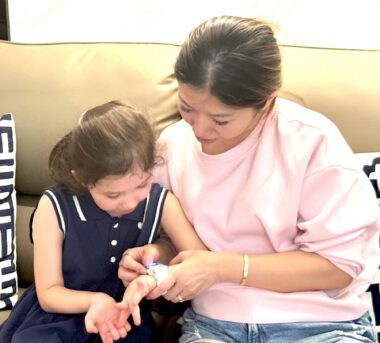
Rylae-Ann excitedly explores her new smartwatch with her mom, Judy. (Photo by Richard E. Poulin III)
At first, Judy and I focused on all the reasons not to buy it. We worried about distractions. We worried about overstimulation. We worried about introducing another piece of technology into her life. Then we actually started looking at the features and realized this thing was less of a “tiny social media machine” and more of a “portable peace of mind.”
The GPS tracking immediately stood out. Parents of children with rare diseases understand that independence can feel both exciting and terrifying at the same time. We want our children to grow, explore, and build confidence, but we also know they may process situations differently or need extra help during stressful moments. Knowing we could quickly locate Rylae-Ann if needed gave us reassurance we did not expect.
The calling features were another major benefit. Instead of a full smartphone with unlimited distractions, the watch allows communication only with approved contacts. For a child with anxiety, being able to quickly video call Mom, Dad, or even Grandma during transitions, outings, or unfamiliar situations can make a huge difference. Sometimes just hearing our voices helps her regulate emotionally.
There were also practical features that surprised us. The fitness tracking encourages movement, which is important for children with low muscle tone and developmental delays. There is even a heart rate tracker with notifications and an oxygen saturation monitor, all of which are important to parents who pay attention to every little detail. I sent a recommendation to the company to add blood sugar monitoring, as well. I haven’t heard back.
The school mode disables distractions during learning time, which helps satisfy the educator side of our brains. There is even an emergency contact feature that allows quick communication if she ever needs help.
Of course, no technology is perfect. Within the first few days, our photo gallery somehow became filled with blurry pictures of the ceiling, random toys, and one incredibly unflattering close-up of Rylae-Ann’s nostril. Apparently, this is simply part of the smartwatch parenting experience.
Still, what surprised me most was not the technology itself, but what it represented. For our family, this little watch was not about giving our daughter another gadget. It was about giving her confidence while giving us a little peace of mind. Parenting a child with a rare disease often forces you to rethink your assumptions. Things you once dismissed suddenly become meaningful tools for communication, safety, independence, and emotional support.
As educators, Judy and I still believe technology can absolutely become a distraction. But sometimes, when used intentionally and carefully, it can also become something else entirely. In our case, it became one more small tool helping our daughter navigate a world that has not always been built for children like her.
Note: AADC News is strictly a news and information website about the disease. It does not provide medical advice, diagnosis, or treatment. This content is not intended to be a substitute for professional medical advice, diagnosis, or treatment. Always seek the advice of your physician or other qualified health provider with any questions you may have regarding a medical condition. Never disregard professional medical advice or delay in seeking it because of something you have read on this website. The opinions expressed in this column are not those of AADC News or its parent company, Bionews, and are intended to spark discussion about issues pertaining to aromatic l-amino acid decarboxylase deficiency.

Leave a comment
Fill in the required fields to post. Your email address will not be published.