Why awareness about rare disease must begin in school
Hearing stories like my daughter's helps students see the difference they can make
Written by |




When people hear about a rare disease, they often assume they will never encounter it. The word “rare” suggests distance — something that happens somewhere else, to someone else.
The truth is very different. In the U.S., about 1 in 10 people live with a rare disease. While exact numbers vary across regions, it is reasonable to believe the proportion in Asia is similar. That means rare disease is already present in our communities, classrooms, and families.
For my family, a rare disease is not an abstract concept. It is part of our everyday life.
Our daughter, Rylae-Ann, was born with aromatic l-amino acid decarboxylase (AADC) deficiency, a rare genetic condition that affects the production of important neurotransmitters such as dopamine and serotonin. When she was an infant, we did not yet know what was wrong. She struggled to nurse, had weak muscle tone, and missed early developmental milestones. After months of uncertainty, she was diagnosed around Christmas in 2018. Less than a year later, at just 18 months, she received gene therapy through a clinical trial.
Today, nearly six years later, Rylae-Ann has made remarkable progress. Many of the severe symptoms that once defined her early life are now minimized or gone. But her journey is still ongoing. She continues to work toward developmental milestones that many children reach more easily. Like many families in the rare disease community, we find ourselves navigating a space that is sometimes difficult to explain. Our child is no longer critically ill, yet she still faces challenges that require understanding and support.

Awareness in schools
Schools are where children first learn how to see the world and how to behave toward the people around them. As a middle school principal, I see this every day. Students are naturally curious. When they learn about rare diseases and the experiences of children who live with them, their response is often empathy rather than fear. They ask thoughtful questions. They begin to understand that differences are part of the human experience. Education creates awareness, and awareness builds inclusion.
When students hear stories like Rylae-Ann’s, they begin to imagine how they might make a difference in the future. Some of them may grow up to become scientists or researchers who develop the next generation of treatments. Others may become doctors, therapists, engineers, educators, or policymakers. Even those who choose completely different careers can carry the mindset that inclusion matters. Designing classrooms, workplaces, technology, and communities with diverse needs in mind benefits everyone.
Specialized school
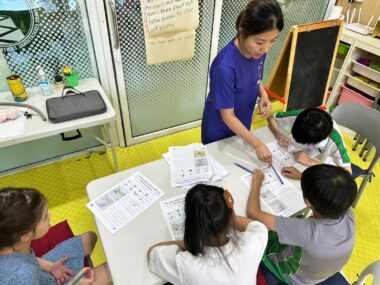
Rylae-Ann learns with her friends at Pathway Educational Center as her mother, Judy Poulin, delivers a lesson. (Photo by Richard E. Poulin III)
My wife, Judy, has also turned our family’s experience into action. As a special education teacher, she opened Pathway Educational Center to support Rylae-Ann and other students who need more individualized attention than traditional schools can often provide. A smaller school environment offers many advantages. Students receive focused support, flexible pacing, and a schedule structured around their developmental and therapeutic needs.
Recently, Judy has begun partnering with other area schools to host collaborative learning days. These experiences allow students from Pathway to interact with peers in different learning environments while also giving teachers and students from partner schools an opportunity to see inclusive education in action. It is a powerful exchange. One group gains exposure to new environments, while the other gains a deeper understanding of diverse learning needs.
Moments like these remind us that awareness is not only about information. It is about connection.
Each year around Rare Disease Day, I share our family’s story with students and read one of our children’s books about rare disease to younger classes. Sitting in a classroom with curious students, holding a book that was inspired by our daughter’s journey, I am reminded why these conversations matter. Awareness does not require grand gestures. Sometimes it simply starts with a story, a question, or a new perspective.
Rare disease awareness should start in schools because schools shape the next generation. When students learn early that differences deserve understanding and inclusion, they carry that lesson into the world.
And that is where real change begins.
Note: AADC News is strictly a news and information website about the disease. It does not provide medical advice, diagnosis, or treatment. This content is not intended to be a substitute for professional medical advice, diagnosis, or treatment. Always seek the advice of your physician or other qualified health provider with any questions you may have regarding a medical condition. Never disregard professional medical advice or delay in seeking it because of something you have read on this website. The opinions expressed in this column are not those of AADC News or its parent company, Bionews, and are intended to spark discussion about issues pertaining to aromatic l-amino acid decarboxylase deficiency.

Leave a comment
Fill in the required fields to post. Your email address will not be published.