
Bowling toward independence: When I became the spare
A simple daddy-daughter day turns into a chance for Rylae-Ann to own her lane
Written by |





There are moments in parenting that feel small when they happen, but later you realize they carry the weight of everything you have been working toward. For me, one of those moments happened at a bowling alley.
My daughter, Rylae-Ann, was born with a rare disease called aromatic l-amino acid decarboxylase (AADC) deficiency. In the early years, our world looked very different from what we imagined. Milestones were not measured in months. They were measured in hope, persistence, and a lot of trial and error.
Before her gene therapy, even basic movement and communication were a challenge. Judy and I were not thinking about enrichment activities or weekend outings. We were focused on survival and development. Every decision, every routine, every small win mattered.
After gene therapy, everything shifted.
We entered a new phase filled with possibilities. Progress came, but not all at once. It came in layers. As educators, Judy and I did what we naturally do. We planned. We structured. We adapted. But more importantly, we made a commitment that Rylae-Ann would not just work on skills. She would experience childhood.
That meant we had to rethink what “typical” activities looked like.
We became experts at modification. Parks, playgrounds, games, holidays — everything had to be adjusted just enough for her to participate, but not so much that it took away the joy. That balance is harder than it sounds. Which brings me to bowling.

Bowling breakthrough
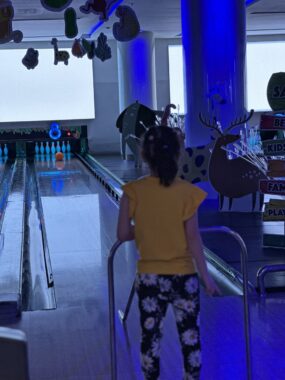
Rylae-Ann proudly watches her bowling ball roll straight down the middle of the lane. (Photo by Richard E. Poulin III)
I planned a simple daddy-daughter day. Nothing complicated. Just us, a bowling alley, and the hope that she would enjoy trying something new. Now, I am not unrealistic. I came prepared.
I asked for the bumper lanes. No shame in that. I also grabbed one of those metal bowling guides that lets you roll the ball down instead of trying to throw it. In my mind, I had already mapped out how this would go. I would help her carry the ball. I would position everything. We would celebrate any small success.
Classic educator mindset. Plan for the scaffolding. What I did not plan for was Rylae-Ann deciding she did not need me.
On her very first turn, she watched carefully. You could almost see her processing. Then she walked over, picked up the bowling ball, and started carrying it toward the ramp. I held my breath. Not because I thought she couldn’t do it, but because I was used to helping.
She lined it up, gave it a push, and sent the ball rolling down the lane. It was not fast. It was not powerful. But it was hers. And then it hit all the pins. The display above the lane lit up with a giant red X.
Her reaction was immediate joy. The kind that fills the whole space and makes you forget everything else. From that roll on, I was no longer the coach. I was the spectator.
She went back, grabbed the ball again, carried it with determination, set it up, and rolled it down. Over and over again. By the third frame, she had completely taken over the system I thought I had built for her.
At one point, she looked at me like I was slowing her down. Then came the ultimate moment. She took my turn. “Daddy, I’ll show you how!”
No discussion. No negotiation. Just pure confidence. She grabbed the ball and showed me how it’s done. I stood there, slightly confused, slightly proud, and slightly wondering if I had just lost my role in this activity entirely.
I realized something in that moment. For years, Judy and I have worked to close developmental gaps. We have structured days, built routines, and intentionally designed experiences to help Rylae-Ann grow. And while that work matters deeply, it is easy to forget the bigger goal.
It is not just about catching up. It is about letting go. Letting her try. Letting her struggle. Letting her surprise us.
That day at the bowling alley was not about perfect technique or high scores. It was about independence. Confidence. Joy. And a gentle reminder that sometimes the best thing we can do as parents is step back just enough to watch our child step forward.
Even if it means losing your turn.
Note: AADC News is strictly a news and information website about the disease. It does not provide medical advice, diagnosis, or treatment. This content is not intended to be a substitute for professional medical advice, diagnosis, or treatment. Always seek the advice of your physician or other qualified health provider with any questions you may have regarding a medical condition. Never disregard professional medical advice or delay in seeking it because of something you have read on this website. The opinions expressed in this column are not those of AADC News or its parent company, Bionews, and are intended to spark discussion about issues pertaining to aromatic l-amino acid decarboxylase deficiency.

Leave a comment
Fill in the required fields to post. Your email address will not be published.