
Learning about rare disease through education and by sharing our own story
One student choosing to become more compassionate makes it all worth it
Written by |




I stood in front of a room full of middle school students on Feb. 27, the day before Rare Disease Day, and asked a simple question: “How many of you think you have ever met someone with a rare disease?”
A few hands slowly went up. Most did not. Those who did remembered my speech from a previous year.
Then I shared a statistic that always surprises people. In the U.S., about 1 in 10 people are affected by a rare disease. That means in a classroom of 30 students, three of them could be directly impacted, either personally or through a family member. While I am not certain of the exact number in Asia, it is reasonable to expect a similar figure. Rare diseases are individually uncommon, but collectively, they are not rare at all.
That was the starting point for our conversation.

Putting a face to ‘rare’
For my wife, Judy, and me, rare disease is not a concept. It is our daughter.
Our daughter, Rylae-Ann, was diagnosed in December 2018 with aromatic l-amino acid decarboxylase (AADC) deficiency, a rare neurological condition that affects the body’s ability to produce important neurotransmitters. At that time, we were living in uncertainty, searching for answers while watching her struggle with low muscle tone, feeding challenges, and delayed development.
Judy is a licensed special education teacher, and I suddenly found myself learning medical terminology we never expected to know. We moved from being typical new parents to becoming caregivers, researchers, and advocates almost overnight.
Almost a year later, Rylae-Ann received gene therapy through a clinical trial. That moment changed the trajectory of her life. The progress did not happen overnight, and it certainly was not magical, but slowly, we began to see strength where there had been weakness, stability where there had been fragility, and possibility where there had once been fear.
Today, she is thriving in her own unique way. She works hard in therapy. She goes to school. She laughs loudly. She loves books. And she continues to surprise us.
This is why I speak.
Helping students understand
When I talk to students about rare diseases, I avoid overwhelming them with medical details. Instead, I focus on three ideas:
- Rare does not mean invisible.
- Different does not mean less.
- Kindness and inclusion matter.
We talked about what it feels like to be the only one who cannot run as fast, speak as clearly, or participate in the same way. I asked them to imagine how powerful it is when someone chooses to include rather than to exclude.
Students are remarkably compassionate when given the opportunity to understand.
I explained that rare diseases are often genetic, lifelong, and misunderstood. But I also emphasized something equally important: People with rare diseases are not defined only by their diagnosis. They are artists, readers, athletes, siblings, and friends.
Rylae-Ann is not a diagnosis. She is a little girl who loves music and stories, and who sometimes insists on staying up later than she should.
Sharing our story through books
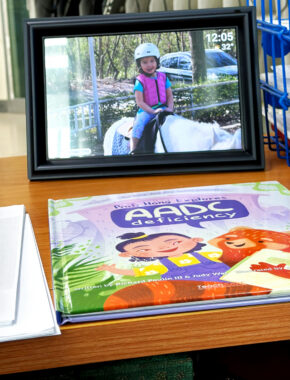
A children’s book by Richard E. Poulin III rests beside a digital frame that shows Rylae-Ann riding her horse, a reminder of the journey behind the story and the reason he shares it. (Photo by Richard E. Poulin III)
One of the most meaningful parts of the day was reading from my children’s book. Storytelling has become one of the ways our family processes our journey and invites others into it.
We currently have two of my books in our school’s library, and another one is set to be published very soon. Seeing those books on the shelves alongside other titles is more emotional than I expected. It is a reminder that our story, once filled with uncertainty and hospital visits, now sits in a place of learning and imagination.
When I read to the students, I watched their faces carefully. They were not looking at me with pity. They were listening with curiosity. They asked thoughtful questions. They wanted to know how they could be good friends to someone who learns or moves differently.
That is the power of education.
How we choose to celebrate
Some families celebrate Rare Disease Day by hosting fundraisers or running social media campaigns. We celebrate through education and storytelling. Standing in front of students and answering questions, and publishing books that share our journey.
Rare disease has shaped our family in ways we never anticipated. It has stretched us, humbled us, and strengthened us. It has also introduced us to a community of resilient families worldwide.
If one student leaves that room more aware, more compassionate, or more willing to include someone who seems different, then the day has accomplished its purpose.
Rare disease may be part of our story. But education and hope are how we choose to tell it.
Note: AADC News is strictly a news and information website about the disease. It does not provide medical advice, diagnosis, or treatment. This content is not intended to be a substitute for professional medical advice, diagnosis, or treatment. Always seek the advice of your physician or other qualified health provider with any questions you may have regarding a medical condition. Never disregard professional medical advice or delay in seeking it because of something you have read on this website. The opinions expressed in this column are not those of AADC News or its parent company, Bionews, and are intended to spark discussion about issues pertaining to aromatic l-amino acid decarboxylase deficiency.


BookkeeperLive
This article highlights how powerful education and storytelling can be in raising awareness about rare diseases. Personal experiences often help people understand conditions that might otherwise remain invisible, and sharing those stories can create empathy, encourage research, and connect families facing similar challenges. For many rare conditions, awareness is the first step toward better support and medical progress, since millions of people worldwide are affected but often remain underrepresented in public discussion. The emphasis on learning, advocacy, and open dialogue in this piece shows how education can transform personal struggles into a broader effort to inform and inspire others.