
The power of play: How game night became our daughter’s best therapy
Board and card games have become occupational therapy for Rylae-Ann
Written by |





My wife, Judy, and I have always been a competitive couple. Backgammon? Intense. Canasta? Ruthless. Ping-Pong? Fast-paced! Trash talk was common, laughter was loud, and someone usually demanded a rematch. Naturally, when our daughter, Rylae-Ann, was born, we assumed she’d be drafted straight into family game night.
Then life dealt us a very different hand.
Rylae-Ann was diagnosed with the ultra-rare disease aromatic l-amino acid decarboxylase (AADC) deficiency, a condition that severely affects movement, muscle tone, and overall development. The diagnosis sent us on a detour we never expected. But if there’s one thing educators are stubborn about, play is never wasted time.
So while our game shelf didn’t look like everyone else’s, the spirit of game night never disappeared. We found ways to adapt.

Games before gene therapy
Before gene therapy, our gaming would not have impressed any toy company. Judy and I held Rylae-Ann in our arms and rolled a single die. We gently helped her count the spaces with her fingers. We cheered like she’d won an Olympic gold medal just for landing on the next square.
Most of our games were improvised. Play-Doh became a “mission” to squish, roll, or poke. Bubble-blowing turned into a competitive sport of how many we could pop before gravity won. To outsiders, it probably looked like we were just passing the time.
In reality, Judy and I were working together to support Rylae-Ann in learning hand-over-hand coordination, visual tracking, cause and effect, sensory processing, and attention. These are all core components of occupational therapy. And just as importantly, we were building connection and joy. Therapy doesn’t always look clinical. Sometimes it looks like a parent on the floor, cheering over bubbles.
Leveling up
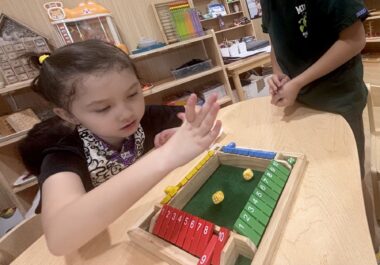
Rylae-Ann Poulin plays a traditional Thai game with a friend that helps her improve her math skills. (Photo by Richard E. Poulin III)
After gene therapy, as Rylae-Ann slowly gained more muscle control and finger dexterity, Judy and I were able to step things up.
One of the first “official” board games we introduced was Candy Land. Bright colors. Simple rules. No reading required. It was perfect. She loved playing with Grandma and Grandpa, carefully placing her piece on the board, proudly drawing cards.
Those game nights rivaled an hour-long occupational therapy session. Fine motor skills, turn-taking, visual scanning, and early executive functioning were all wrapped in sugar-coated squares and family laughter.
As Rylae-Ann grew older, Uno became our favorite game. Flights, hospital waiting rooms, and hotel floors were all perfect places for a quick match. Rylae-Ann was learning pattern recognition, matching, impulse control, and early strategy. She even beat both Judy and me more times than we’d like to admit. Nothing humbles you faster than losing to your own child while holding a draw 4 card.
The golden era of game night
Now that she’s 7, the real competition has begun. Our house has become a rotating demo booth for popular board and card games. Exploding cats, throwing burritos, and pantomiming games lead to a room full of cheerful screams and laughter.
Beyond the noise and silliness, these games continue to build bilateral coordination, motor planning, emotional regulation, working memory, problem-solving, and social communication. They also teach valuable character traits, such as how to lose, how to win graciously, and how to recover when a flying foam burrito hits you square in the face.
No matter where your child is developmentally, games offer something powerful. They offer novelty, repetition, and connection with your child. They meet children where they are and gently pull them forward, often without them even realizing they’re learning.
For us, board games aren’t just entertainment. They’re therapy, education, and memory-making rolled into one slightly competitive package.
We’re still that competitive couple. We’ve just learned that the real win isn’t the score. It’s the laughter around the table.
Note: AADC News is strictly a news and information website about the disease. It does not provide medical advice, diagnosis, or treatment. This content is not intended to be a substitute for professional medical advice, diagnosis, or treatment. Always seek the advice of your physician or other qualified health provider with any questions you may have regarding a medical condition. Never disregard professional medical advice or delay in seeking it because of something you have read on this website. The opinions expressed in this column are not those of AADC News or its parent company, Bionews, and are intended to spark discussion about issues pertaining to aromatic l-amino acid decarboxylase deficiency.



Leave a comment
Fill in the required fields to post. Your email address will not be published.