
The lessons from the first 7 years that helped us stop chasing a timeline
I'm now less concerned about statistics and more focused on our journey
Written by |





During my teacher training, one concept stuck with me: the first critical period of brain development occurs very early in life, between ages 2 and 7. At the time, it felt like one of those powerful, slightly intimidating facts professors love to emphasize. You nod, write it down, and move on.
Then my wife and I became parents. Then we became parents of a child with an ultra-rare disease.
And suddenly, that concept was no longer just a line in my notes. It was a quiet voice in the back of my mind, whispering, “Time is of the essence.”
Judy, my wife, and I have always believed that the early years are not just important; they are essential. Before we even had the language to explain it, we felt it. The way young children absorb the world, the way small routines shape big outcomes, the way learning happens in moments that do not look like learning at all. With our daughter, Rylae-Ann, who’s now 7, that belief was not just philosophical. It became our daily practice.

Before gene therapy
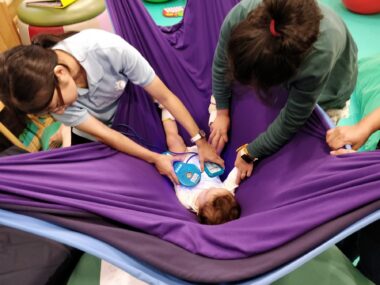
Before gene therapy, Rylae-Ann already had a full schedule of early intervention therapies. (Photo by Richard E. Poulin III)
Rylae-Ann was born with aromatic l-amino acid decarboxylase (AADC) deficiency, a rare genetic condition that affects the production of key neurotransmitters such as dopamine and serotonin. Before her diagnosis, we knew something was different. She struggled with feeding, muscle tone, and development. Milestones didn’t come as the parenting books promised. Eventually, our Christmas in 2018 became one we would never forget, as we received the diagnosis that would change everything.
Even before gene therapy entered our lives, early intervention had already begun. It didn’t look like a formal program at first. It looked like two parents learning how to support their daughter in every possible way. Feeding became therapy. Play became therapy. Holding, positioning, encouraging, waiting, trying again. We didn’t call it a “program.” We just called it life.
Then came gene therapy when Rylae-Ann was 18 months old. Hope arrived, but so did a new level of responsibility.
After gene therapy
After gene therapy, intensive therapy became part of our daily rhythm. There was physical therapy, occupational therapy, and speech therapy. Schedules filled up quickly, but what mattered more was what happened between the sessions. We made a conscious decision to embrace what I often describe as a caregiver lifestyle. Therapy was not something that happened for one hour in a clinic. It was woven into our entire day.
Standing became a game. Reaching became play. Sounds became conversations. We found ways to turn ordinary routines into opportunities for growth. If there was a way to practice a skill, we tried it. If there was a way to repeat it, we did. Not perfectly, not always successfully, but consistently. We understood that this window of time was unique. Neuroplasticity was on our side. Our daughter’s brain was ready to grow, adapt, and build new pathways. Our job was to give it every possible reason to do so.
As Rylae-Ann’s eighth birthday approaches, I ask myself, “Did we do enough? Did we make the most of this small window of time?”
It is an honest question, and I think many parents, especially those on a rare disease journey, have asked themselves a similar one. When so much feels at stake, it is easy to measure yourself against an invisible standard.
But then I pause, and I look at Rylae-Ann.
Defying statistics

Rylae-Ann continues to defy statistics and enjoy life every step of the way. (Photo by Richard E. Poulin III)
We were told she would never walk. Today, she walks. We were told she would never speak. Today, she not only speaks; she negotiates. Bedtime has somehow turned into a nightly debate, and I don’t always win.
We were told many things about raising a child. And one by one, those things have been rewritten. So maybe the question isn’t whether we maximized that development window. Maybe it’s whether we showed up every day with love, effort, and belief.
And the answer to that is yes.
We showed up when progress was slow. We showed up when it was uncertain. We showed up when we were tired. We showed up with no idea what we were doing and learned along the way.
As we look ahead to Rylae-Ann’s eighth birthday on April 1, I find myself feeling less concerned about the timeline and more focused on the journey.
Because if the past eight years have taught us anything, it is this. Statistics are helpful, but they are not destiny. Progress does not end at 7. Learning does not stop because a number says it should. And children, especially those who have already defied so much, are capable of far more than we can measure.
So we will keep going. We will keep building, playing, learning, and, yes, negotiating bedtime. We will continue to embrace the caregiver lifestyle that has carried us this far. And most importantly, we will continue to believe that the best chapters of Rylae-Ann’s story are still being written.
Note: AADC News is strictly a news and information website about the disease. It does not provide medical advice, diagnosis, or treatment. This content is not intended to be a substitute for professional medical advice, diagnosis, or treatment. Always seek the advice of your physician or other qualified health provider with any questions you may have regarding a medical condition. Never disregard professional medical advice or delay in seeking it because of something you have read on this website. The opinions expressed in this column are not those of AADC News or its parent company, Bionews, and are intended to spark discussion about issues pertaining to aromatic l-amino acid decarboxylase deficiency.




Leave a comment
Fill in the required fields to post. Your email address will not be published.