
My daughter looks great in her school uniform, but putting it on is a challenge
Zippers and fasteners have become a big barrier to Rylae-Ann's independence
Written by |





Our daughter, Rylae-Ann, looks wonderful in her new school uniform. I realize I may be slightly biased, but she wears it with the confidence of someone ready to take on the world, or at least Grade 2.
Getting into that uniform, however, sometimes feels like completing an obstacle course before the school day has even begun.
The shirt has small buttons with buttonholes that seem determined to remain closed. Fastening them requires precision, steady fingers, and the patience of someone defusing a tiny fabric-covered bomb. Then there is the pleated skirt. It requires Rylae-Ann to reach behind her back, locate a small zipper, pull it upward, and secure a clasp she cannot easily see.
For many children, these tasks are minor inconveniences. For children with fine motor, coordination, or mobility challenges, they can become significant barriers to independence.
Rylae-Ann has made extraordinary progress since receiving gene therapy for aromatic l-amino acid decarboxylase (AADC) deficiency. She has gone from being unable to sit independently to walking, running, swimming, reading, and attending school. Yet small buttons and hidden clasps can still humble her and her parents.
Some mornings, our family’s greatest opponent is not AADC deficiency. It is a button approximately the size of a pea.

Designing so all children are successful
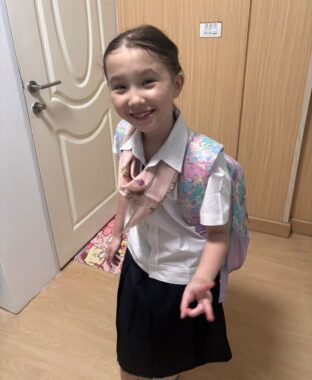
Rylae-Ann poses proudly in her school uniform. (Photo by Richard E. Poulin III)
Over the past year, Rylae-Ann learned alongside her mother, Judy, through homeschool. Her education was built around the principles of Universal Design for Learning, commonly called UDL. The basic idea is that environments should be designed to give people different ways to participate, learn, and demonstrate what they know.
With her mom, adaptations were not treated as special favors. They were simply part of good lesson design. If one method created an unnecessary barrier, another option was offered. The goal was never to make everything easier. It was to make success accessible.
Returning to a mainstream school has reminded us that these principles have not yet fully extended into the wider world. Most systems, including her school uniform, are designed around an assumed “typical” user. When someone cannot use them as intended, they are often expected to adapt to the system. We are trying to reverse that thinking.
Instead of asking why Rylae-Ann cannot manage her uniform quickly enough, we ask what modifications would allow her to dress independently. Could the small buttons be replaced with magnetic fasteners or hidden snaps? Could the skirt use an elastic waistband, a side zipper, or a larger pull tab? Could clothing look exactly like the standard uniform while being easier for more students to manage?
These changes may sound small, but independence is often built through small victories. The best part is that this principle benefits all students.
We continue to push for independence and work on “typical” features Rylae-Ann may encounter. Dressing without assistance can strengthen confidence, privacy, self-determination, and a child’s sense of belonging. Inclusive clothing can also help children with arthritis, cerebral palsy, muscular disorders, limb differences, sensory sensitivities, and many other disabilities.
It can even help tired parents at 6:30 in the morning, which should be considered an important accessibility feature.
We are not asking the world to abandon its uniform or lower expectations. We are learning how to adapt the existing systems so children like Rylae-Ann can participate successfully and independently.
Rylae-Ann’s uniform has taught us that inclusion is not only about entering the classroom. It is also about everything a child must navigate to get there. She has already overcome obstacles far greater than a button or zipper. Still, the world should not keep placing unnecessary barriers in her path simply because “that is how clothing has always been made.”
Sometimes inclusion begins with changing a system. Other times, it begins with changing a button.
Note: AADC News is strictly a news and information website about the disease. It does not provide medical advice, diagnosis, or treatment. This content is not intended to be a substitute for professional medical advice, diagnosis, or treatment. Always seek the advice of your physician or other qualified health provider with any questions you may have regarding a medical condition. Never disregard professional medical advice or delay in seeking it because of something you have read on this website. The opinions expressed in this column are not those of AADC News or its parent company, Bionews, and are intended to spark discussion about issues pertaining to aromatic l-amino acid decarboxylase deficiency.

Leave a comment
Fill in the required fields to post. Your email address will not be published.