
How we support our child while encouraging her independence
What a caregiver has learned about helping his daughter with AADC deficiency
Written by |





“Don’t do everything for your child.” As an educator and father, I have heard this advice countless times and even given it. The reasoning is sound. Children need opportunities to struggle, solve problems, and develop independence.
However, when your child has a rare neurological disorder that affects her ability to move, even the simplest tasks can become monumental challenges. My wife, Judy, and I learned that the difference between encouraging independence and creating frustration often comes down to knowing when to lend a hand.
After eight years of parenting our daughter, Rylae-Ann, we have become experts at lending hands. Sometimes arms, legs, and occasionally our entire backs!

Dreaming of independence
Rylae-Ann has aromatic l-amino acid decarboxylase (AADC) deficiency, an ultrarare genetic disorder that affects the production of essential neurotransmitters, including dopamine and serotonin.
Before receiving gene therapy in Taiwan in November 2019, at just 18 months old, she struggled to sit independently, hold objects, or feed herself. Tasks most parents take for granted were enormous challenges.
Following gene therapy, progress was remarkable but not overnight. It required a balanced schedule of physical and occupational therapy, repetition, encouragement, and creative parenting.
As educators, Judy and I understood scaffolding: supporting learners as they develop skills, then gradually removing assistance. We just had to apply it beyond the classroom.
Our living room became a therapy center filled with foam blocks, toys, and adaptive equipment. We guided Rylae-Ann’s hands to turn pages, press elevator buttons, and explore objects. As her motor control improved, we stepped back. Perfection was never the goal; participation was. Eventually, assisted movements became independent achievements.
School uniform challenge
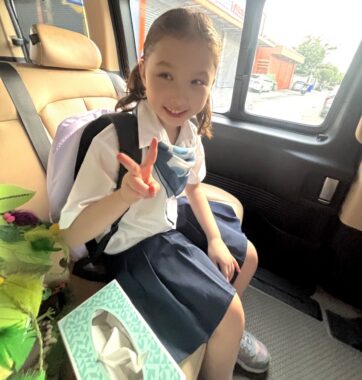
Rylae-Ann confidently smiles on her way to school. (Courtesy of Richard E. Poulin III)
Today, Rylae-Ann is an energetic second grader who loves reading, swimming, horseback riding, and physical education. She walks, runs, dresses herself, and manages many activities independently. Yet fine motor tasks remain challenging. Consider the school uniform. Whoever designed tiny shirt buttons and the zipper on the back of a pleated skirt clearly never consulted an occupational therapist!
Rylae-Ann can manage much of her dressing, but small buttons and hard-to-reach zippers demand considerable coordination.
Should we refuse to help because independence matters? Of course not.
Instead, we lay out clothes, break tasks into steps, and use easier fasteners when appropriate. Sometimes we start a tricky task and let her finish; other times, we assist with one step so she can complete the rest.
Our mornings feature encouragement, praise, and my occasional celebratory dance. I suspect my dancing has done more damage to her confidence in my coordination than anything else!
Nevertheless, she laughs, tries again, and becomes increasingly capable.
When to step away
Doing everything for a child differs from providing the support necessary for success. From feeding and dressing to writing and playground activities, we adapt equipment, allow extra time, or recognize when exhaustion calls for a break.
We also learned to step back. Initially, we sometimes stayed nearby to help Rylae-Ann participate at school. As her confidence developed, we gave her space.
Now, watching her enter school and engage with classmates reminds us how far she has come. Writing still requires support, and physical activities sometimes need adaptations. But support and independence are not opposites. Often, one makes the other possible.
Honoring the hands that help
In honor of National Family Caregivers Month this November, I dedicate this column to parents, grandparents, siblings, spouses, and loved ones who provide care every day.
Caregiving is often invisible. People celebrate first steps, buttoned shirts, and confident walks into school. Behind these milestones lie countless hours of practice, adaptation, patience, and love. Much happens when nobody is watching.

Richard, Rylae-Ann, and Judy Poulin make memories after a long day. (Photo by Richard E. Poulin III)
Caregivers rise early for therapy, stay up researching treatments, and celebrate victories others overlook. Many receive little recognition or don’t even call themselves caregivers. They simply act out of love.
To every caregiver: Helping someone become independent does not diminish their accomplishments. Your support often makes those accomplishments possible.
This November, I hope we recognize not only the extraordinary individuals overcoming challenges but also the extraordinary people standing beside them. For Judy and me, our greatest reward is watching Rylae-Ann need us a little less each year. There is something beautifully bittersweet about helping someone become more independent of you.
Of course, I suspect she will always need her dad for something. Perhaps a stubborn zipper, a little encouragement, or someone to embarrass her with an enthusiastic victory dance. If she eventually masters every zipper, button, and shoelace without my help, I will happily retire from those duties.
But the embarrassing dad dancing? Sorry, Rylae-Ann. That’s a lifelong caregiving commitment!
Note: AADC News is strictly a news and information website about the disease. It does not provide medical advice, diagnosis, or treatment. This content is not intended to be a substitute for professional medical advice, diagnosis, or treatment. Always seek the advice of your physician or other qualified health provider with any questions you may have regarding a medical condition. Never disregard professional medical advice or delay in seeking it because of something you have read on this website. The opinions expressed in this column are not those of AADC News or its parent company, Bionews, and are intended to spark discussion about issues pertaining to aromatic l-amino acid decarboxylase deficiency.


Leave a comment
Fill in the required fields to post. Your email address will not be published.