
Harnessing the power of books early in our daughter’s AADC deficiency journey
Reading stories helps children develop empathy and social understanding
Written by |





When our daughter, Rylae-Ann, was diagnosed with aromatic l-amino acid decarboxylase (AADC) deficiency at just 8 months old, the future felt uncertain. AADC deficiency is a rare genetic disorder that affects the body’s ability to produce important neurotransmitters such as dopamine and serotonin.
The result can be severe developmental delays, low muscle tone, movement disorders, feeding difficulties, sleep challenges, and significant barriers to communication. The statistics were not encouraging.
Many children with AADC deficiency never develop the skills that most parents take for granted. Yet from the very beginning, my wife, Judy, and I made a conscious decision to acknowledge the reality of the diagnosis without allowing statistics to define our daughter’s potential.

Long before Rylae-Ann could sit independently, point to a picture, or even babble, we read to her. At the time, it probably looked a little ridiculous. Judy and I became puppeteers. We pointed to pictures, exaggerated our voices, turned pages, and acted out stories for a little girl who often seemed unable to fully interact with the books in front of her.
We didn’t know what she could understand or retain. We only knew that exposure mattered. So we kept reading every day, even when progress seemed invisible.
Then came gene therapy when Rylae-Ann was 18 months old. Slowly, her world began to expand. She developed greater control over her movements. She started reaching for pictures. She learned to help turn pages. Eventually, she could hold books on her own.
That was when something remarkable happened: Her love of reading took off.
Reading to learn
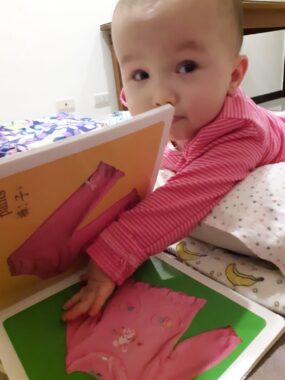
After receiving gene therapy, Rylae-Ann enjoys turning pages in her book during tummy time exercises. (Photo by Richard E. Poulin III)
Today, Rylae-Ann reads independently and well beyond her grade level. As an educator, I am proud of her academic growth. However, achieving a reading level is only a small part of the story. The greatest gift books have given our daughter isn’t literacy — it’s perspective.
Research consistently shows that reading stories helps children develop empathy, social understanding, and moral reasoning. When children immerse themselves in narratives, they are exposed to different viewpoints, emotions, and life experiences. They learn to recognize feelings, understand motivations, and consider the consequences of choices.
These skills can be particularly challenging for many children to develop because they require abstract thinking and forming a perspective. Stories provide a safe space to practice both.
Through books, Rylae-Ann has learned about friendship, kindness, courage, perseverance, honesty, and compassion. She has met characters who made mistakes and learned from them. She has seen heroes overcome obstacles and ordinary people make extraordinary choices.
Many of the conversations that followed story time became opportunities to discuss real-life situations. How should we treat others? Why is honesty important? How do we respond when someone is different from us? What does it mean to be brave?
These lessons are difficult to teach through lectures alone. Stories bring them to life.
Books also helped us create memories together. Some of our favorite family moments happened curled up on the couch, sitting in therapy waiting rooms, or reading before bedtime. Certain stories instantly transport us back to specific stages of our journey. A well-loved book becomes more than paper and ink. It becomes part of a family’s history.
Our belief in the power of books eventually extended beyond our own home. Over the years, Judy and I have volunteered our time and donated resources to help publish children’s books focused on rare diseases through our nonprofit, Teach RARE. Our advocacy efforts are focused on empowering parents and educating the community. One of our many initiatives has been to create stories that raise awareness, encourage inclusion, and help children understand differences.
We hope these books do more than educate. We hope they inspire.
Perhaps a child who reads one of these stories will grow up to become a physician in search of answers. Perhaps they will become researchers developing treatments. Perhaps they will become teachers creating inclusive classrooms. Or perhaps they will simply become a kinder and more understanding person.
Looking back, I’m grateful that we started reading to Rylae-Ann long before she could turn a page herself. Books helped support her learning, strengthen our family bond, and teach lessons that extend far beyond academics.
Note: AADC News is strictly a news and information website about the disease. It does not provide medical advice, diagnosis, or treatment. This content is not intended to be a substitute for professional medical advice, diagnosis, or treatment. Always seek the advice of your physician or other qualified health provider with any questions you may have regarding a medical condition. Never disregard professional medical advice or delay in seeking it because of something you have read on this website. The opinions expressed in this column are not those of AADC News or its parent company, Bionews, and are intended to spark discussion about issues pertaining to aromatic l-amino acid decarboxylase deficiency.

Leave a comment
Fill in the required fields to post. Your email address will not be published.