
There was no road map for what to do after gene therapy for AADC deficiency
After the treatment, our aim became to try to maximize its benefits
Written by |





My wife, Judy, and I recently traveled back to Taiwan so that our daughter could continue contributing data to her gene therapy clinical trial, and we got to catch up with many of the doctors who have been part of her journey.
We also met several families whose children recently received gene therapy through Taiwan’s National Health Insurance (NHI). The country approved the full reimbursement of the treatment through its national healthcare system earlier this year, and since then, about one child a month has undergone the procedure.
While we were there, a parent asked us what the very first therapy was that we did after gene therapy. The question instantly transported us back nearly seven years. It’s funny how a single question can unlock a flood of memories.
Rylae-Ann was born with aromatic l-amino acid decarboxylase (AADC) deficiency, a rare genetic disorder that prevents the body from producing enough dopamine and serotonin. Before gene therapy, she couldn’t sit independently, crawl, or speak. Like many families facing a rare disease, we measured progress in tiny victories.
Gene therapy gave us hope. It gave Rylae-Ann the opportunity to develop skills we once thought might never come. But once the surgery was over, another question quickly surfaced: Now what?
There was no instruction manual waiting for us. No checklist titled, “Life After Gene Therapy.” We had become pioneers, and pioneers rarely get maps.

Turning our apartment into a therapy center
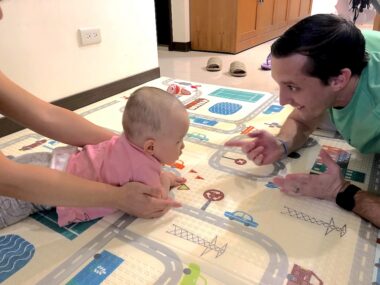
An MNRI therapist guides Rylae-Ann through reflex integration exercises while her father, Richard E. Poulin III, lies on the floor beside her, offering encouragement. (Courtesy of Richard E. Poulin III)
Judy has never been one to wait around for someone else to figure things out. While I was busy celebrating every new wiggle, smile, and movement, she was researching every therapy she could find that might help Rylae-Ann maximize the benefits of gene therapy.
That search led her to Masgutova Neurosensorimotor Reflex Integration, better known as MNRI. A month after gene therapy, an MNRI therapist was making regular visits to our apartment, which soon began to look like a rehabilitation clinic. Mats covered the floor. Therapy equipment multiplied overnight.
During each session, I would lie on the mats, my face level with Rylae-Ann, trying to keep her calm and study. I honestly had no idea what I was watching, but I took mental notes anyway. The therapist gently moved Rylae-Ann through various positions, applied pressure to different parts of her body, and worked through reflex patterns I had never heard of. At one point, I wondered if they were rebooting her nervous system like an old computer.
Rylae-Ann, meanwhile, cried her lungs out. From the moment the therapist walked through the door until she finished the session and handed her back to Judy, the crying never stopped. Judy immediately picked her up and offered a bottle of formula, which Rylae-Ann happily gulped down. It was the quickest way to restore peace.
Despite my confusion, one thing was crystal clear. We were going to give our daughter every opportunity we possibly could.
Small decisions over time
At that stage, nobody knew exactly what recovery after gene therapy would look like. Every child in the clinical trial was teaching the medical community something new. Every family was discovering what worked through trial, observation, and perseverance.
Was every new movement because of gene therapy? Was it MNRI? Was it simply time? Was it all of them working together? The honest answer is that we still do not know.
What I do know is that success rarely comes from one breakthrough. It usually comes from hundreds or even thousands of small decisions made consistently over time.
MNRI became one piece of a much larger puzzle. It was followed by physiotherapy, occupational therapy, speech therapy, intensive practice at home, homeschooling, reading together, and finding creative ways to make every activity an opportunity to learn. None of those pieces worked in isolation. Together, they created an environment where Rylae-Ann could thrive.
Today, when people see her running, reading above grade level, swimming independently, or enthusiastically explaining facts about space, they are seeing the result of years of persistence that began in that little apartment in Taiwan.
If our experiences can make the path just a little clearer for the next family receiving this life-changing treatment, then every therapy session, every question, and every uncertain step has been worth it. Sometimes the greatest gift we can leave behind is not a perfect answer, but a trail of footprints that gives someone else the confidence to keep moving forward.
Note: AADC News is strictly a news and information website about the disease. It does not provide medical advice, diagnosis, or treatment. This content is not intended to be a substitute for professional medical advice, diagnosis, or treatment. Always seek the advice of your physician or other qualified health provider with any questions you may have regarding a medical condition. Never disregard professional medical advice or delay in seeking it because of something you have read on this website. The opinions expressed in this column are not those of AADC News or its parent company, Bionews, and are intended to spark discussion about issues pertaining to aromatic l-amino acid decarboxylase deficiency.

Leave a comment
Fill in the required fields to post. Your email address will not be published.