
When therapy looks like a video game for our daughter with AADC deficiency
Mario Kart is not a treatment, but it can provide cognitive and physical benefits
Written by |





Our daughter, Rylae-Ann, was born with aromatic l-amino acid decarboxylase (AADC) deficiency, a rare genetic disorder that affects the brain’s ability to produce dopamine and serotonin. Before receiving gene therapy in Taiwan in 2019, she couldn’t sit independently, crawl, walk, or speak. Today, she runs, attends school, argues with her parents, and regularly reminds us that independence sometimes comes with very strong opinions.
Throughout her journey, my wife, Judy, and I have taken a somewhat traditional approach to therapy. Physical, occupational, and speech therapy have always formed the foundation of Rylae-Ann’s development. However, we’ve also ventured into less conventional areas, including horse therapy, drama therapy, and aqua therapy.
Whatever the setting, we try to carry the lessons home. Therapy doesn’t end when an appointment finishes. We adapt exercises, incorporate movement into daily routines, and disguise learning as play whenever possible. Children tend to be much more enthusiastic when they don’t realize their parents have secretly turned playtime into therapy.
After purchasing Rylae-Ann a smartwatch, we decided to take our most technologically advanced step yet. We bought Rylae-Ann a Nintendo Switch 2.

Our very scientific justification
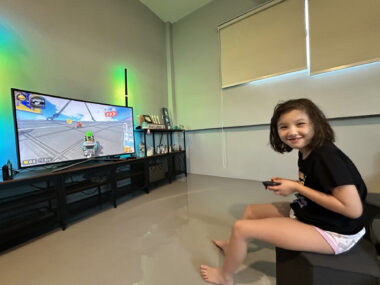
Rylae-Ann wakes up early to play Mario Kart with her dad. (Photo by Richard E. Poulin III)
Out loud, we explained that video games could help improve Rylae-Ann’s coordination, thinking, reaction time, fine motor control, problem-solving, and ability to follow multistep directions. The Switch 2’s detachable Joy-Con controllers also offer motion controls, vibration feedback, and mouse-style controls in compatible games. Different games can require players to plan, remember instructions, track moving objects, make quick decisions, and coordinate what they see with precise finger movements.
It all sounded very educational. In reality, we may have also wanted an excuse to play Mario Kart together.
Still, there is research supporting our argument. A study of more than 2,200 children found an association between video gaming and slightly better performance on tasks involving working memory and response inhibition. Researchers have also examined active video games, sometimes called exergames, as potential tools to support executive function and motor skills in children.
The important word is “possible.” Video games are not a miracle treatment, and the research does not prove that handing a child a controller will automatically improve development. The type of game, the child’s needs, the length of play, and the involvement of an adult all matter.
For Rylae-Ann, the most obvious challenge is coordinating both hands. One thumb may need to steer while another presses a button, and another finger may be responsible for an entirely different command. For most gamers, this happens automatically. For a child who has spent years developing fine motor control, it can be a serious workout. This was what sparked the discussion about video games in the first place.
Learning to lose and try again
The cognitive and physical benefits are only part of what we have observed. Video games also create opportunities to practice patience, flexibility, communication, and emotional regulation.
When Rylae-Ann cannot complete a level, she becomes frustrated. Sometimes she asks for advice. Sometimes she hands me the controller because her fingers cannot press the correct button combination quickly enough. Occasionally, she explains that the game is broken. This diagnosis is usually delivered immediately after she loses.
I try not to take over too quickly. Instead, I show her what to do, break the task into smaller steps, and encourage her to try again. It is similar to the support we provide during therapy. The goal is not for me to complete the level but for her to experience a challenge, receive the right amount of help, and eventually succeed.
The Switch also gives us another way to play as a family. We laugh, compete, solve problems, and celebrate victories together. After Rylae-Ann falls asleep, Judy and I occasionally continue playing. This is, of course, only so we can thoroughly evaluate the games before she uses them. Good parenting requires sacrifice.
Keeping screens in their proper place
Judy and I still limit Rylae-Ann’s screen time and monitor what she plays. Gaming does not replace outdoor play, reading, schoolwork, sleep, family conversation, or her regular therapies. We choose age-appropriate games, play alongside her, and stop when frustration becomes overwhelming or the controller starts to look like it might become airborne.
The Switch 2 is not a medical device, and Mario is not a licensed therapist. However, when used intentionally, video games can offer meaningful opportunities to practice coordination, planning, persistence, and communication. More importantly, they can bring a family together.
Sometimes therapy looks like stretching on a mat, practicing sounds, riding a horse, or working in a swimming pool. Other times, it looks like three people sitting on a sofa, laughing as a digital kart drives directly off the side of a rainbow-colored road.
Note: AADC News is strictly a news and information website about the disease. It does not provide medical advice, diagnosis, or treatment. This content is not intended to be a substitute for professional medical advice, diagnosis, or treatment. Always seek the advice of your physician or other qualified health provider with any questions you may have regarding a medical condition. Never disregard professional medical advice or delay in seeking it because of something you have read on this website. The opinions expressed in this column are not those of AADC News or its parent company, Bionews, and are intended to spark discussion about issues pertaining to aromatic l-amino acid decarboxylase deficiency.


Leave a comment
Fill in the required fields to post. Your email address will not be published.