
Learning to swallow pills represents a milestone for my daughter
A spoonful of patience helps the medicine go down
Written by |





One of the less glamorous benefits of returning to school is apparently getting access to every germ circulating among children.
Our daughter, Rylae-Ann, was born with aromatic l-amino acid decarboxylase (AADC) deficiency, a rare genetic disorder that affects the brain’s ability to produce important neurotransmitters such as dopamine and serotonin. Before treatment, she had severe developmental delays, low muscle tone, movement difficulties, and frequent oculogyric crises that caused her eyes to roll or become fixed upward.
At 18 months old, Rylae-Ann received experimental gene therapy in Taiwan. The treatment delivered a working copy of the DDC gene directly into her brain. Since then, her life has changed dramatically. Over the years, she has learned to sit, crawl, walk, run, read, swim, ride a scooter, and attend school.
Unfortunately, gene therapy does not make you immune to whatever is being passed around the playground.
Recently, Rylae-Ann became sick again. Being back in school means she spends her days surrounded by children, and children are incredibly talented at sharing everything, especially germs. Thankfully, one major difference we see now is how much stronger she has become. When Rylae-Ann was younger, respiratory illnesses could become frightening very quickly. We once nearly lost her to respiratory syncytial virus, which led to severe lung inflammation and a weeklong hospitalization. Today, she gets sick, but she generally recovers faster.

Inflamed lungs
This illness was still a rough one. Her lungs became inflamed, and she developed severe bronchitis. She missed several days of school, although “missing school” is apparently a flexible term in our family.
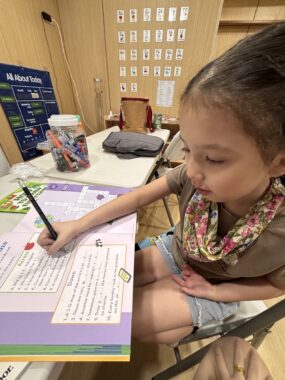
While away from school due to illness, Rylae-Ann continued to learn. (Courtesy of Richard E. Poulin III)
While recovering, she went with my wife, Judy, to Pathway Educational Center, where Judy works. Judy was delighted to have her there for some homeschooling. Rylae-Ann probably felt differently about the arrangement.
They played games, did activities, read, and learned plenty. Judy does not really believe in taking a day off from education just because your lungs have declared a temporary rebellion. The bigger challenge came with the medicine.
Since Rylae-Ann was little, we have usually dissolved medicine and given it to her through a syringe. Then we quickly followed it with one of her favorite sweet drinks.
A spoonful of sugar may help the medicine go down, but in our house, a syringe followed by juice works, too. Mary Poppins would be proud.
This time, however, the doctor prescribed two large pills that could not be dissolved. He was also quite clear that she needed to take them.
Judy and I developed our strategy. We explained what the medicine was, why she needed it, and how swallowing the pills was similar to taking one of those enormous bites of dessert we are constantly telling her not to take. Ironically, the skill we normally discourage was suddenly medically useful.
It was go time. I placed the first pill toward the back of her tongue and quickly gave her cold water. She immediately spit out a wet, chalky pill. Round 1 went to Rylae-Ann.
We reassured her, explained it again, and after only a little debate, she agreed to try once more. This time, she swallowed it. Judy and I cheered like she had just scored the winning goal in a championship game. Rylae-Ann smiled. She was clearly proud of herself.
Then came pill No. 2. She was still not thrilled about the situation, but now she knew she could do it. That pill went down on the first attempt. More cheering.
The next day surprised us even more. Instead of asking me to place the medicine in her mouth, Rylae-Ann wanted to do it herself. She put the pill on her tongue, took some water, and swallowed it.
Then she did the same with the second pill. No drama. No negotiations. No chalky pill flying across the room. Another skill unlocked.
I certainly hope swallowing pills is not something she needs to practice very often. But it represents something much bigger.
Nearly seven years after gene therapy, we are still discovering new milestones. Some are enormous, like walking into school. Others are small enough to fit on the tip of your finger.
Progress doesn’t always arrive with fireworks. Sometimes it comes quietly, one uncomfortable swallow at a time. And once again, Rylae-Ann reminded us that given enough patience, confidence, support, and perhaps a little sweet drink, progress keeps coming.
Note: AADC News is strictly a news and information website about the disease. It does not provide medical advice, diagnosis, or treatment. This content is not intended to be a substitute for professional medical advice, diagnosis, or treatment. Always seek the advice of your physician or other qualified health provider with any questions you may have regarding a medical condition. Never disregard professional medical advice or delay in seeking it because of something you have read on this website. The opinions expressed in this column are not those of AADC News or its parent company, Bionews, and are intended to spark discussion about issues pertaining to aromatic l-amino acid decarboxylase deficiency.


Leave a comment
Fill in the required fields to post. Your email address will not be published.