
What I’d tell my younger self outside my daughter’s operating room
Looking back, I wish I had celebrated some of those tiny victories a little longer
Written by |





Nearly seven years ago, my wife, Judy, and I handed our daughter over to a surgical team in Taiwan for an experimental gene therapy. It was November 2019. Rylae-Ann was 18 months old and living with aromatic l-amino acid decarboxylase, or AADC, deficiency.
We had spent months searching for answers, followed by more months searching for hope. Gene therapy represented both. But hope did not make us any less terrified.
We had so many questions. Would the surgery work? Would there be complications? How much progress could she make? Would she ever sit independently? Walk? Talk? Nobody could tell us. There was no road map. All we really knew was that this was her chance, and we were going to take it.

Looking back at the road after gene therapy
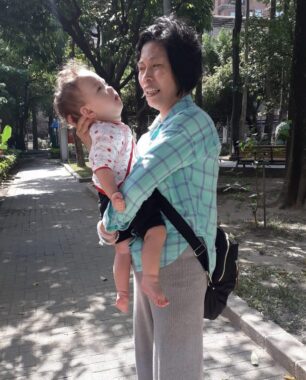
Rylae-Ann is carried by her grandmother at a park in Taiwan in November 2019, one week before gene therapy. (Courtesy of Richard E. Poulin III)
After gene therapy, our lives became intensely focused on progress. Physical therapy, occupational therapy, speech therapy, exercises at home, swimming, stretching, playing, practicing, repeating, and then probably repeating everything one more time because Judy and I are educators and apparently incapable of leaving homework at school.
That determination mattered. Rylae-Ann worked incredibly hard. So did we. Therapy gave her opportunities to develop skills, build strength, and explore what her changing body could do.
But looking back, I realize something else was happening. We were constantly worried that we were not doing enough. There was no milestone chart for us to follow. Nobody could say, “At six months after gene therapy, she will do this. At two years, she will do that.”
Instead, the instructions felt more like: See how far she can go. So we pushed.
Then she made progress, and we pushed a little further. I am incredibly proud of that determination, but I wish I could go back to those exhausted parents in 2019 and tell them something.
“Don’t worry. In time, your daughter will walk. She will learn to read. She will go to school.”
I think Judy and I would have hugged each other, cried, and then immediately taken the longest nap in recorded human history.
Knowing that would not have changed our commitment to therapy. It would not have made us work any less. But it might have allowed us to breathe a little more. Because progress after gene therapy did not arrive as one dramatic moment. It came in pieces.
A little more head control. Sitting longer. Moving across the floor. Crawling. Standing. A few steps. Then more steps. Eventually, those steps became running.
Learning by looking back
If someone had told me in 2019, “Before Rylae-Ann turns 8, she will run, swim independently, ride horses, read books, and attend school,” I am not sure I would have believed them. Actually, I probably would have asked to see their medical credentials. Yet here we are.

Rylae-Ann attends a school party in September 2026. (Photo by Richard E. Poulin III)
That is why I think one of the hardest lessons for parents navigating gene therapy, rehabilitation, or any long medical journey is learning to respect time.
We naturally want to know the destination. We want milestones, timelines, percentages, and guarantees. Sometimes there simply aren’t any.
That uncertainty can make every therapy session feel like a test. Every delayed skill can feel like a warning. Every comparison with another child can create unnecessary pressure. But our children are not racing against a stopwatch.
Looking back, I wish I had celebrated some of those tiny victories a little longer, instead of immediately wondering what came next.
Today, we still have goals for Rylae-Ann. We still work on challenges, and we still wonder what the future holds. The difference is that I have seen what time can do.
So if I could sit beside the younger version of myself waiting outside that operating room in November 2019, I would not give him a milestone chart.
I would simply tell him: Keep going. Keep believing in her. Do the work, but enjoy your daughter along the way. Some of the moments you are desperately waiting for will come. And when they do, you may wish you had spent a little less time worrying about when they would arrive and a little more time enjoying the journey that got you there.
Note: AADC News is strictly a news and information website about the disease. It does not provide medical advice, diagnosis, or treatment. This content is not intended to be a substitute for professional medical advice, diagnosis, or treatment. Always seek the advice of your physician or other qualified health provider with any questions you may have regarding a medical condition. Never disregard professional medical advice or delay in seeking it because of something you have read on this website. The opinions expressed in this column are not those of AADC News or its parent company, Bionews, and are intended to spark discussion about issues pertaining to aromatic l-amino acid decarboxylase deficiency.



Leave a comment
Fill in the required fields to post. Your email address will not be published.