
Looking back at a key developmental milestone following gene therapy
A trip prompts memories of a special Christmas dinner that changed everything
Written by |





Six and a half years ago, my wife, Judy, and I placed our trust in a medical team in Taiwan and handed our daughter, Rylae-Ann, over for a surgery we hoped would change her future. Today, we continue returning to Taiwan, not because Rylae-Ann needs another operation, but because she continues to contribute valuable data to the clinical trial that helped save her life.
Our daughter was born with aromatic l-amino acid decarboxylase (AADC) deficiency, an ultra-rare genetic disorder that affects the body’s ability to produce important neurotransmitters such as dopamine and serotonin. In simple terms, the brain struggles to send messages to the body. Children with AADC deficiency often experience severe developmental delays, low muscle tone, feeding difficulties, sleep disturbances, and episodes known as oculogyric crises, where the eyes become fixed upward.
When Rylae-Ann was diagnosed at just 8 months old, the future looked uncertain. At the time, there were very few treatment options available. Through a combination of persistence, luck, and one life-changing Facebook post shared by Judy’s brother, we learned about a gene therapy clinical trial in Taiwan led by Professor Paul Wuh-Liang Hwu, MD, PhD, and his team at National Taiwan University Hospital.

That discovery set our family on a journey that would ultimately lead to Taiwan in November 2019. At just 18 months old, Rylae-Ann underwent gene therapy surgery. The procedure delivered a healthy copy of the defective gene directly into her brain. We hoped and prayed for progress. What happened next exceeded anything we could’ve imagined.
Today, six and a half years later, Rylae-Ann can run, swim, read independently, ride horses, and participate in activities that once seemed impossible. Every follow-up appointment reminds us how fortunate we are and how important these clinical trials are for future families facing the same diagnosis.
A favorite family memory
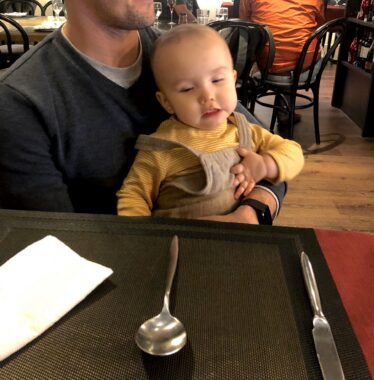
After launching a fork across the restaurant during Christmas dinner, Rylae-Ann was quickly transferred to her dad’s lap to prevent any additional utensils from taking flight. (Photo courtesy of Richard E. Poulin III)
During our most recent trip to Taiwan, we arrived early, before Rylae-Ann’s annual medical tests. We got to be tourists, spending time exploring Taipei. As we walked through our favorite mall, Judy suddenly stopped and pointed toward a restaurant.
“Oh! Here is where we had Christmas dinner!” she exclaimed. Immediately, memories came rushing back.
Following surgery, Rylae-Ann had remained in Taiwan with her grandmother and nanny for the first few months of recovery while Judy and I continued working in Singapore. We flew back whenever possible, but Christmas was one date we absolutely refused to miss.
At the time, Rylae-Ann was only one month post-gene therapy. The doctors had encouraged us to take things slowly and avoid unnecessary outings. Looking back, that was probably wise advice. Yet Christmas only comes once a year, and after everything our family had endured, staying indoors simply didn’t feel right.
So we ventured out for a short holiday dinner. Even before we reached the restaurant, we could tell something was different. Rylae-Ann seemed more alert, engaged, and curious about the world around her.
Then came the moment Judy and I will never forget. Sitting in her high chair, completely unsupported, Rylae-Ann looked around the table. The shiny silverware immediately captured her attention. Before gene therapy, she had never really reached for objects with purpose.
Suddenly, she grabbed a fork. And not only did she grab it, but she launched it across the restaurant like a tiny Olympic javelin thrower. The fork clattered loudly onto the floor several tables away.
Judy and I immediately gasped. Then we started cheering.
To everyone else in the restaurant, it probably looked like we were celebrating terrible behavior. The people sitting nearby stared at us with expressions that seemed to say, “Those parents really need a parenting class.”
What they couldn’t possibly understand was that this was the first time our daughter had intentionally grabbed and thrown an object. We weren’t celebrating bad behavior; we were celebrating a milestone.
The dinner lasted only a short time. The food was good, but neither of us can remember what we ordered. What we remember is the fork. Years later, that tiny moment remains one of our favorite family memories.
As we continue returning to Taiwan to support ongoing research, we are reminded that clinical trial data is more than numbers on a chart. Behind every data point is a child, a family, and a collection of memories that once seemed impossible.
For our family, one of those memories will always be a particular Christmas dinner, a flying fork, and two parents cheering loudly enough to make an entire restaurant question their sanity. And I wouldn’t change a thing.
Note: AADC News is strictly a news and information website about the disease. It does not provide medical advice, diagnosis, or treatment. This content is not intended to be a substitute for professional medical advice, diagnosis, or treatment. Always seek the advice of your physician or other qualified health provider with any questions you may have regarding a medical condition. Never disregard professional medical advice or delay in seeking it because of something you have read on this website. The opinions expressed in this column are not those of AADC News or its parent company, Bionews, and are intended to spark discussion about issues pertaining to aromatic l-amino acid decarboxylase deficiency.


Leave a comment
Fill in the required fields to post. Your email address will not be published.