
We wrote ‘Reawaken’ so no rare disease family has to feel alone
We didn't set out to write a book, but to understand what was happening to us
Written by |





Even before our daughter, Rylae-Ann, was diagnosed with aromatic l-amino acid decarboxylase (AADC) deficiency, my wife, Judy, began taking meticulous notes. We were not writing a book. We were just trying to understand what was happening to our family.
AADC deficiency is an ultra-rare genetic disorder that affects the brain’s ability to produce important neurotransmitters, including dopamine and serotonin. Before treatment, Rylae-Ann could not hold up her head, sit independently, speak, or control many of her movements. She experienced painful dystonic episodes and oculogyric crises, during which her eyes would roll upward and become fixed.
Judy and I spent months searching for answers. We traveled from Singapore to Taiwan, chased research papers across the internet, contacted doctors around the world, and learned enough medical vocabulary to become extremely annoying at appointments.
Rylae-Ann finally received her diagnosis on Christmas Day in 2018. It was not the present we had hoped to unwrap.
The impossible begins to happen
Less than a year later, in November 2019, she received an experimental gene therapy as part of a clinical trial at National Taiwan University Hospital. There were no guarantees. We only knew that without treatment, her future was frighteningly uncertain.
Then, slowly, the impossible began to happen.
Rylae-Ann learned to hold herself upright. She sat independently, crawled, stood, walked, and eventually ran. Gestures became sounds. Sounds became words. Words became full conversations, usually involving very detailed explanations of why she should not have to do something we had asked her to do.
Notes became our outline
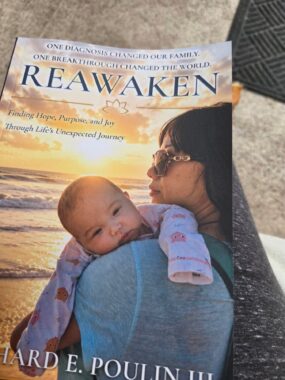
The first printed copy of “Reawaken,” which tells the story of the Poulin family’s journey with AADC deficiency, arrived at the author’s doorstep last week. (Photo by Richard E. Poulin III)
Years later, those notes Judy took, along with our memories and late-night reflections, have become a book.
Our new memoir, “Reawaken: Finding Hope, Purpose, and Joy Through Life’s Unexpected Journey,” tells the story of our family’s journey through misdiagnosis, rare disease, caregiving, clinical research, and gene therapy. It is also the story of a marriage, a family, and a little girl who repeatedly challenged what we thought was possible.
Although my name appears on the cover, this has always been our story. Judy lived every page with me. In many cases, she remembered the details I had forgotten, expanded on other details, and reminded me of our triumphs. That is why the book is also credited to Judy.
Writing “Reawaken” required returning to some of the most painful moments of our lives. I revisited hospital rooms, emergency visits, sleepless nights, medical mistakes, and the fear that Rylae-Ann might never receive the help she needed. Some chapters were difficult to write. Others reminded me that even during our darkest days, our family still found reasons to laugh.
That humor was important to preserve. Rare disease is serious, but caregiving is also filled with absurd moments. Sometimes you cry in a hospital hallway. Sometimes you celebrate a bowel movement. Occasionally, you do both on the same day.
I did not write this book because our family has all the answers. We certainly do not. Gene therapy changed Rylae-Ann’s life, but it did not end her journey. She continues to work through physical, sensory, emotional, and academic challenges. Progress still requires therapy, patience, adaptation, and an impressive number of negotiations.
I wrote the book because I remember how alone Judy and I felt when AADC deficiency first entered our lives. We desperately searched for another family who understood. Medical articles provided facts, but we also needed something more personal. We needed to know how people survived the fear, made impossible decisions, and continued finding joy.
Our goal with publishing
Our hope is that “Reawaken” can offer that companionship to another family.
The book is not only for families affected by AADC deficiency. It is for parents, caregivers, educators, medical professionals, and anyone whose life has suddenly taken a direction they never planned for. At its heart, it is about what happens when the future you imagined disappears, and you must begin building a different one.
It is also about the extraordinary power of science, community, and hope. Rylae-Ann’s progress was made possible by researchers, physicians, therapists, advocates, relatives, friends, and families who came before us. Every person who shared information or opened a door became part of her story.
For years, I have shared pieces of our journey in this column. Now, for the first time, the full story is together in one place. Seeing the finished book was emotional. It represented six years of fear, work, love, and progress. Rylae-Ann, however, was mainly interested in finding the pages about herself.
Honestly, I cannot blame her. She is clearly the best character!
Note: AADC News is strictly a news and information website about the disease. It does not provide medical advice, diagnosis, or treatment. This content is not intended to be a substitute for professional medical advice, diagnosis, or treatment. Always seek the advice of your physician or other qualified health provider with any questions you may have regarding a medical condition. Never disregard professional medical advice or delay in seeking it because of something you have read on this website. The opinions expressed in this column are not those of AADC News or its parent company, Bionews, and are intended to spark discussion about issues pertaining to aromatic l-amino acid decarboxylase deficiency.

Leave a comment
Fill in the required fields to post. Your email address will not be published.