
This rare disease family showcased its adaptability as floodwaters rose
We didn't get the school week we planned, so we came up with a new plan
Written by |





Just when we thought life was returning to normal, Bangkok decided we needed a swimming pool outside our front door.
Our daughter, Rylae-Ann, had just returned to school after recovering from a lung infection and severe bronchitis. After several days at home, she was finally feeling better and ready to get back into her routine.
Then the rain came. And kept coming.
Nearly 300 millimeters (11.8 inches) of rain fell across Bangkok in 48 hours, flooding roads and neighborhoods across the city. Schools closed, families were encouraged to stay home, and suddenly Rylae-Ann was right back where she had been the week before: home.
Thankfully, if my wife, Judy, and I have learned anything from raising a child with aromatic l-amino acid decarboxylase (AADC) deficiency, it is adaptability. We also had something else going for us: experience. We survived COVID-19 lockdowns. We knew the drill.

Flood days
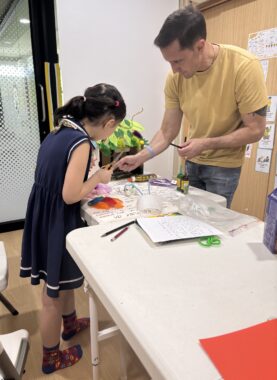
Rylae-Ann completes her diorama project with a little help from her dad. (Courtesy of Richard E. Poulin III)
Our mornings started early with physical therapy and what I call “gym play,” which is basically exercise disguised well enough that Rylae-Ann doesn’t realize her dad has turned playtime into therapy.
Afterward, we headed upstairs for breakfast with Judy. I logged on to start my workday while Judy and Rylae-Ann got ready for theirs.
About an hour later, they came downstairs and transformed our home into a classroom.
They started with literacy. Instead of pretending the flooding wasn’t happening, Judy used it as a learning opportunity. Rylae-Ann read about weather and used the flood happening outside our home as inspiration for writing.
Every so often, I would emerge from my online meetings to offer encouragement, praise her work, and remind everyone that I was still an important member of the teaching team. Then I returned to my computer before Judy could assign me anything.
Next came science. Rylae-Ann had to prepare a rainforest diorama for an upcoming school showcase. What could have been a simple arts-and-crafts project became a lesson about ecosystems, habitats, plants, and rainforest animals. Judy brought out children’s books, pictures, and materials while Rylae-Ann constructed her miniature rainforest.
Before lunch, it was my turn again. We practiced how she would present her project, focusing on speaking clearly and confidently. Years ago, we were working to help Rylae-Ann produce words. Now I was coaching her on presentation skills. Her skill in presenting confidently leaves me proud beyond words.
Then came one of the unexpected benefits of online learning: lunch together as a family. Granted, my leisurely family lunch usually lasted approximately seven minutes before I disappeared into another online meeting or met with a teacher.
After lunch came math, an area where Rylae-Ann still needs additional support. Judy used manipulatives and hands-on activities to make abstract concepts easier to understand. Most importantly, Rylae-Ann completed the lesson without tears. For our household, that qualifies as exceeding expectations.
By the end of the day, school gradually disappeared. We played board games or headed back to the gym. Learning, physical therapy, work, and family time somehow blended together.
A new plan
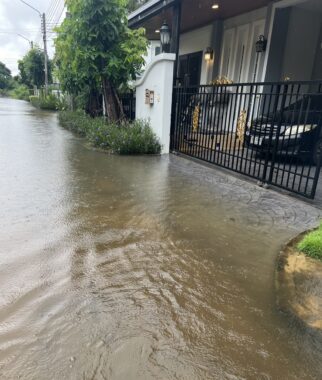
Bangkok floodwaters prevented the Poulin family from leaving their home, but they adapted and continued learning. (Photo by Richard E. Poulin III)
Outside, the floodwaters continued rising. Fortunately, the water never entered our home. I did, however, have to trudge through shin-high water to reach the store. Nothing makes you reconsider how badly you need groceries quite like standing in murky floodwater wondering what just touched your leg.
Still, throughout the week, I kept thinking about adaptability. Rare disease families become experts at it. Plans change. Children get sick. Therapies get canceled. Schools close. Development happens at its own pace. Sometimes, apparently, the street becomes a river.
We cannot control all of those things. What we can control is what happens next.
That week wasn’t the school week we planned. But Rylae-Ann still read, wrote, solved math problems, learned science, practiced presenting, exercised, played, and laughed. And we ate lunch together.
Sometimes resilience isn’t doing something extraordinary. Sometimes it’s simply looking at the water rising outside, opening the laptop, pulling out the rainforest diorama, and saying, “OK, what’s the new plan?”
Note: AADC News is strictly a news and information website about the disease. It does not provide medical advice, diagnosis, or treatment. This content is not intended to be a substitute for professional medical advice, diagnosis, or treatment. Always seek the advice of your physician or other qualified health provider with any questions you may have regarding a medical condition. Never disregard professional medical advice or delay in seeking it because of something you have read on this website. The opinions expressed in this column are not those of AADC News or its parent company, Bionews, and are intended to spark discussion about issues pertaining to aromatic l-amino acid decarboxylase deficiency.


Leave a comment
Fill in the required fields to post. Your email address will not be published.